
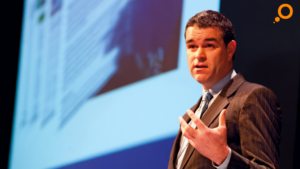
In 2018, OES worked with Professor Hamish Coates, Director of the Higher Education Futures Lab, on the Next Generation Assessment research paper, which explored how assessment could respond to the changing demands facing higher education. We invited him to reflect on what has changed since then, and the opportunities and challenges ahead.
In 2018 you argued that learning, assessment and support would become increasingly integrated. Nearly a decade later, where have we made the most progress, and where has change been slower than you expected?
With OES in 2018 we developed a means for making assessment part of the learning experience. We recognised the need for authentic, personalised assessment that supports learning and makes it engaging and meaningful for students.
Assessment should be integral to learning, not treated as a collection of disconnected tasks that sit apart from the learning journey.
A decade later, the main thing is, people are talking about student learning, assessment and outcomes more than ever. When we started this movement two decades ago, we could never have hoped to see it go mainstream. With diligent development, the coming years look to usher in really significant developments.
In terms of actual progress ‘on the ground’, it has been slower than I expected. Partly, it is always this way – converting ideas into practice always takes much longer than expected. But also, despite its importance, assessment reform has often struggled to compete with the many demands facing academics and institutions. As universities focused on growth, step-change innovation became increasingly challenging.
Even so, institutions have advanced. Universities have established assessment offices and specialist roles, strengthened governance, and expanded assessment options through digital technologies. Importantly, TEQSA, Australia’s national regulator, has placed greater emphasis on outcomes, success and integrity.
However, much more progress could have been made by pursuing innovation to move the sector in a new direction. There is no time like the present.
Digital technologies are creating new opportunities to accelerate that shift, while also introducing new challenges. AI, for example, can create personalised assessment and feedback at unprecedented scale, provided teachers remain responsible for guiding and overseeing its use.
At the same time, AI raises important questions about academic integrity, requiring universities to safeguard the credibility of their qualifications and keep teachers at the centre of learning.
Assessment reform is a complex challenge that requires universities, academics, regulators and experienced education partners such as OES to work together to co-create the next generation of assessment.
Good assessment is a team sport, drawing on expertise in teaching, learning design, technology and accreditation. By bringing these perspectives together, institutions can embed assessment more effectively into everyday teaching and learning. The time to start this work is now.
Through your international work, what are the most promising developments you’re seeing in how universities assess and evidence student learning? How is AI influencing those developments?
The most promising developments fall into two broad categories. The first is the growing attention that governments and universities are giving to the assessment of student learning. When I led the international OECD project in 2008, we had to scratch around to find people with higher education assessment experience, eventually forging teams to make things work. As higher education has expanded, it’s giving rise to new professions and roles, new global communities focused on academic integrity, and more conversations around accreditation activities.
The second is practical innovation in curriculum and education practice. Some newer universities are embedding assessment into real-life experiences, while others are redesigning curriculum around course deliverables such as business proposals and start-up ventures. Countries in Asia and Africa are charting new ways to demonstrate and validate learner capability.
Generally, much of this innovation is happening in rapidly emerging higher education systems with greater flexibility to experiment with new approaches.
Earlier this year, OES released its Connected Assurance Framework, which argues for a more integrated approach to Assurance of Learning. Does that align with what you’re seeing across the sector here in Australia and globally?
Assuring learning and graduate capability is the core business of universities. It always has been. However, the many pressures facing academics and universities today can make it difficult to sustain that focus. Traditional approaches to assuring learning and assessment that served universities well in the 1990s are no longer sufficient for today’s larger, more complex institutions.
Meeting today’s challenges requires a bold, new approach. Australian universities are brilliant at creative innovation. The issue is no longer a lack of ideas but finding ways to put them into practice.
One response to this challenge is OES’ Connected Assurance Framework which brings learning design, educator knowledge of students and assessment together. It is based on the idea that confidence in learning comes from connecting these elements, rather than treating curriculum and assessment as separate activities.
As technology continues to advance, the next five years present a significant opportunity to strengthen individual, institutional and national capability. If government and universities can work together to pioneer a skills-led joined-up tertiary education system, sector and national productivity will soar. The opportunity costs are huge, and the opportunities enormous.
What excites you most about the future of assessment and assurance of learning?
There are so many exciting opportunities ahead as the sector places a sharper focus on student learning and looks for better ways to demonstrate the value universities create for the communities they serve. The opportunities and challenges created by AI have given this work new urgency.
Here are the priorities that could accelerate progress.
- Know what assessments exist: Universities maintain inventories of physical assets yet many lack an institution-wide view of the assessments used to assure student learning.
- Make learning a leadership responsibility: Leaders must be accountable for student learning and achievement, supported by governance, policies and reporting that enable them to fulfil that responsibility.
- Reform assessment: Look beyond incremental improvements. Reform is needed across assessment design, development, implementation, analysis and reporting, supported by digital platforms and AI tools.
- Collaborate to innovate: No university or field can realise the needed change alone – working with expert education designers helps.
- Harness digital innovation: Digital platforms and AI tools can enable sophisticated, personalised assessment experiences that were once beyond the reach of all but the most well-resourced institutions.
- Seek global best practice: Learn from both traditional and emerging higher education systems, particularly in regions such as Asia and Africa.
- Determine integrity as well as intellect: Move beyond assessments that measure knowledge alone and ensure graduates can demonstrate sound judgement, ethical practice, professional behaviours and applied skills.
- Strengthen trust in qualifications: Governments, academic leaders and policymakers must provide direction and support to strengthen learning achievement, uphold standards and build confidence in qualifications.

