
Assurance of Learning in the Age of AI: Strengthening quality, equity and trust through connected assurance
Today we are delighted to launch the OES Assurance of Learning Positioning Paper, following widespread consultation with the Australian higher education sector. This paper sets out a design led, connected approach to Assurance of Learning in the context of AI enabled assessment and evolving regulatory expectations.
OES CEO Jonathan Davey said:
With a growing share of higher education students working full time and increasing demand from geographically remote learners, many simply cannot attend on‑campus lectures and exams. Our industry must respond with pragmatic solutions that preserve access to education while assuring learning outcomes.
As a leading enabler of online education, OES has developed a positioning paper outlining our perspective on how the sector must address this challenge. I thank everyone who contributed to this work and invite you to engage with us as we continue to refine a practical, system‑ready model for connected assurance.”

Purpose and context
As artificial intelligence reshapes assessment practices, academic judgement and student engagement, the central challenge facing universities and regulators is no longer simply preventing misconduct but credibly evidencing learning across diverse delivery contexts and student cohorts.
OES Chief Academic and Partnerships Officer Dr Erin Jancauskas said:
AI has brought questions of equity and trust in assessment into sharp focus, but it also opens the door to meaningful innovation. This moment invites the sector to rethink how we evidence learning – moving toward connected, relational and pedagogically-driven approaches that support diverse learners while strengthening confidence in outcomes across programs and institutions.”
This positioning paper sets out OES’ perspective on how assurance of learning must evolve in response to AI. Drawing on over a decade of experience partnering with Australian and international universities to design and deliver largescale, credentialled online and digitally enabled programs, OES argues that credible assurance in an AI-enabled environment depends on connected, program-level approaches rather than detection led and modality-based controls.
Why this moment matters
Artificial intelligence has reframed assurance of learning as a design challenge rather than a policing problem. Confidence in outcomes depends less on isolated assessment artefacts or security measures, and more on the coherence of curriculum, assessment and teaching practices across an entire program of study. While identity verification and controlled assessment environments play a role, they are insufficient on their own to demonstrate that graduates have genuinely achieved the learning outcomes their qualifications claim.
This challenge coincides with growing reliance on flexible delivery, with around 44 per cent of Australian higher education students studying in external or multimodal modes in 2024. These models are critical for equity cohorts, particularly rural and remote learners, mature age students, students with disability and those balancing work and caring responsibilities.
What is at stake
Decisions made now will shape public trust in Australian qualifications over the coming decade. Fragmented, artefact-only or overly technical approaches to assurance weaken confidence in outcomes and risk prioritising compliance visibility over meaningful evidence of learning.
There is also significant equity risk. Responses to AI that default to narrow security controls or modality-based judgements may disproportionately disadvantage students who rely on flexible provision, including regional and remote learners and students with disability. At a system level, the challenge is to protect academic standards without constraining access while expanding participation in ways that sustain rigour and completion outcomes. Industry expectations must also be considered, particularly the growing demand for graduates who can understand, use and critically engage with AI in the workplace.
OES’ Connected Assurance Framework
OES’ position is that assurance of learning in the age of AI must be built around connected, program-level design. No single mechanism can provide sufficient assurance on its own. Instead, confidence depends on the intentional integration of three interdependent dimensions.
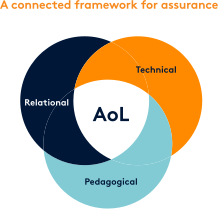
Relational assurance is built through sustained, meaningful engagement between educators and students, enabling informed academic judgement based on observation of learning over time rather than interpretation of isolated artefacts.
Technical assurance establishes appropriate conditions for assessment, including proportionate identity verification and, where required, controlled environments. These mechanisms enable confidence but do not constitute assurance on their own.
Pedagogical assurance focuses on curriculum and assessment design that generates cumulative, coherent evidence of learning across a degree, supporting progression, integration and triangulation of capability.
Together, these dimensions enable institutions to exercise confident academic judgement across diverse delivery contexts. In this framing, connection matters more than modality. The risks associated with AI do not map neatly to online or on-campus delivery, but to whether programs are deliberately designed to make learning visible, integrated and observable over time.
Regulatory alignment
The Connected Assurance Framework is aligned with the intent of the Higher Education Standards Framework and TEQSA’s guidance on assessment reform in the age of artificial intelligence. It supports valid, evidence-based assurance while preserving flexibility in delivery and assessment, enabling regulators to see and trust program-level coherence rather than reliance on single point controls.
From position to practice
OES offers this paper as a contribution to sector dialogue at a time of rapid technological change and heightened scrutiny of assessment and assurance practices. We are actively piloting connected assurance approaches with university partners and will continue to share insights, evidence and outcomes from this work as implementation progresses.
We invite universities, regulators, policymakers, peak bodies and partners who are working to balance quality, equity and trust to collaborate with us. This might look like coming together to share practice, testing the Connected Assurance Framework in your own settings, sharing emerging practice and lessons learnt through implementation. Given our student cohorts we are uniquely interested in strengthening assurance of learning while supporting rural and remote learners and underrepresented student cohorts.
Learn more and access the OES Assurance of Learning Positioning Paper here: www.oes.edu.au/assuranceoflearning

