

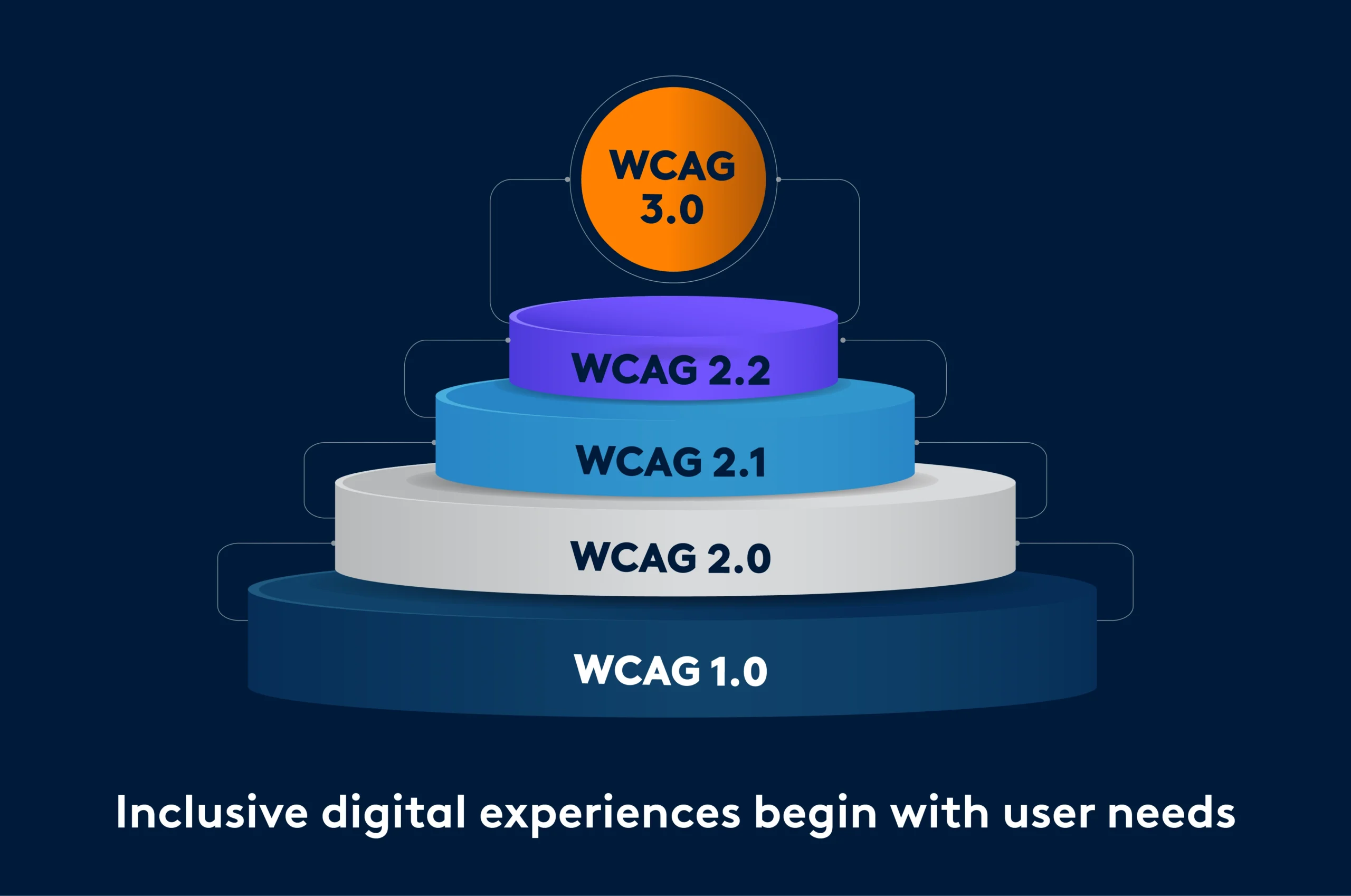
The Web Content Accessibility Guidelines (WCAG) have shaped the global accessibility landscape for more than two decades — from the launch of WCAG 1.0 (1999), to WCAG 2.0 (2008), WCAG 2.1 (2018), and WCAG 2.2 (2023). Each version has expanded the internet’s understanding of what accessible digital experiences should look like. Now, as WCAG 3.0 begins to take shape, accessibility is evolving beyond technical compliance toward a more human-centered model focused on real user needs, cognitive accessibility, and inclusive digital experiences.
The global digital landscape has been scrutinized by regulatory accessibility updates such as those in America’s ADA Title II, Australia’s DDA, and Europe’s EAA. These updates have been a long time coming, and signal a hopeful future for digital inclusivity, one where full and dignified participation in digital spaces is a fundamental right.
Too often, however, organizations reduce the spirit of these regulations to a dogged tunnel vision for minimum compliance. While frantic triage may be the only option for some, the future belongs to organizations that understand accessibility not as a constraint, but as a strategic and cultural commitment to inclusion.
A useful lens for understanding where accessibility is heading is the developing WCAG 3.0 guidelines. Although still a working draft, WCAG 3.0 offers important insight into how digital accessibility is evolving, and what organizations can begin preparing for now.
Accessibility Beyond the Page
One of the most significant changes to WCAG is the broadening of its scope. WCAG 2.X provides guidelines for the accessibility of web pages, with some support for mobile devices and applications. WCAG 3.0 will broaden this scope to include content accessed across different devices, dynamic and interactive media, streaming services, augmented and virtual reality, digital productivity suites, and the tools used to create and manage content.
This expanded scope has particularly significant implications for digital learning environments. In practice, accessibility will no longer apply only to the learning content itself, but to the entire learning experience: from infrastructure to impact.
Learning management systems, authoring tools, and virtual classrooms all become part of the accessibility equation, requiring inclusive design considerations from the outset rather than as a later fix. This means we can look forward to an overhaul of the entire web ecosystem to ensure accessibility is nestled in its DNA.
What this means for organizations
A practical place to start is by adopting a mobile?first mindset. Mobile experiences amplify many of the same constraints faced by disabled users: smaller screens, alternative input methods, environmental distractions, and reliance on assistive technologies. Designing for these realities forces clarity, simplicity, and intentional prioritization, qualities that benefit all users.
A More Human Approach
Perhaps the biggest shift from 2.X to 3.0 is in how accessibility success is framed. WCAG 2.X framed success around the web content itself. It asked, “Is this content perceivable, operable, usable, and robust (POUR) enough for disabled people to use it?” WCAG 3.0 brings the user back into the spotlight and simplifies the question to the infinitely more elegant: “Are user needs being met?”
Technical requirements remain essential, but they are no longer the sole measure of success. Instead, each guideline in WCAG 3.0 is grounded in a documented user need. Requirements describe what must be present to meet that need, while methods provide guidance on how to do so.
Importantly, WCAG 3.0 broadens its inclusivity of approach. Where WCAG 2.X placed greater emphasis on physical and sensory barriers, WCAG 3.0 elevates cognitive accessibility as an equal concern.
In learning environments, this distinction matters. Accessibility has often been verified by confirming the presence of features such as captions or transcripts. Under WCAG 3.0’s user?needs model, the question widens: not just whether those features exist, but whether learners can meaningfully engage with content, reflect on it, and progress independently. In this sense, WCAG 3.0 reinforces a powerful idea: inclusive learning and effective learning are the same thing.
What this means for organizations
This shift challenges organizations to move beyond asking “Can users access this?” toward “Can users understand, engage with, and use this without undue effort?” In practice, this means designing for clarity and simplicity, managing cognitive load intentionally, embedding inclusive design practices into everyday workflows, and recognizing neurodiversity as part of the mainstream audience rather than an edge case.
From Pass/Fail to Progress
The next change is likely to provide much-needed relief for organizations globally. WCAG 3.0 moves away from the traditional binary pass/fail model and introduces a percentage-based scoring system—one that recognizes progress rather than punishing imperfection.
Under this model, accessibility is assessed:
- Across each outcome
- Using multiple testing methods
- With the lowest score determining the overall result
The familiar A, AA, and AAA levels are replaced with bronze, silver, and gold scores. Each score requires all core requirements to be met and a % of the supplemental requirements to be met. This means that organizations are no longer defined solely by what they have not yet achieved. A piece of content that would previously have been deemed “non-compliant” may now sit at a silver level, reflecting meaningful progress.
Crucially, accessibility success is reframed as a journey of continuous improvement, encouraging organizations to start where they are.
What this means for organizations
The new scoring approach removes a major psychological barrier to action. By recognizing progress rather than demanding perfection, WCAG 3.0 makes it safer and more meaningful for organizations to start improving accessibility immediately.
For learning and digital teams, this creates space to experiment, mature practices, and embed accessibility into everyday workflows. Organizations that lean into this mindset now will not only be better prepared for WCAG 3.0—they will already be building more inclusive, trustworthy, and resilient digital experiences.
Preparing for the Next Era of Accessibility
As WCAG 3.0 continues to evolve, it signals a shift toward a more human-centered and inclusive digital world. While the guidelines are not yet final, their draft form should not be considered an opportunity to act.
For learning professionals and digital leaders alike, this is a reminder that accessibility is not a destination to be reached once standards are settled, but an ongoing commitment to meeting people where they are.