

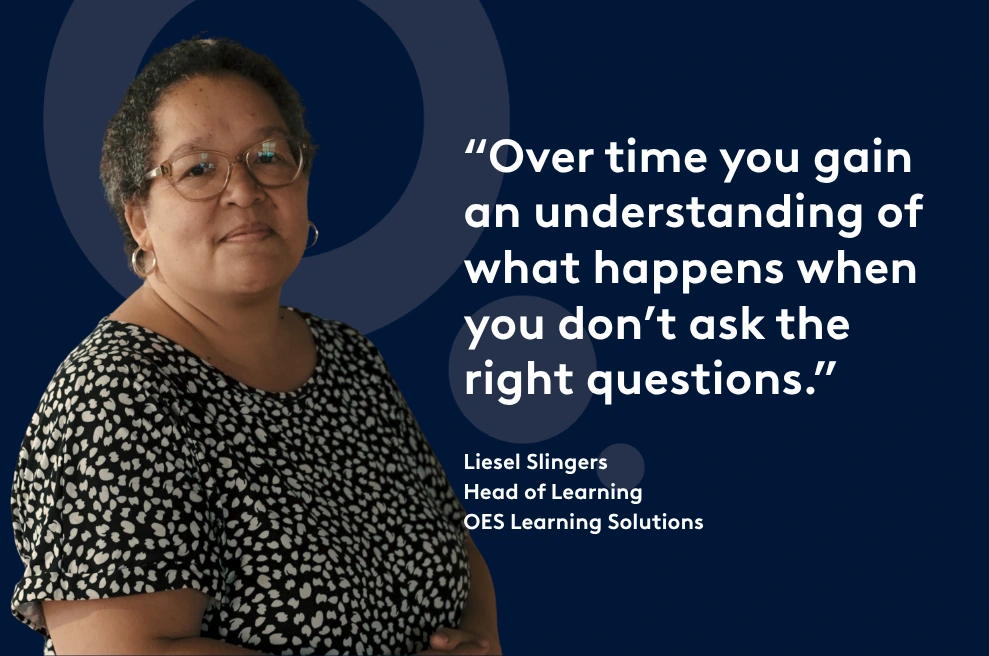
As generative AI reshapes industries, learning design is often seen as fertile ground for automation. But according to Liesel Slingers, Head of Learning at OES Learning Solutions, the reality is far more complex. Drawing on decades of experience in instructional design, Slingers argues that while AI can accelerate content creation, the true value of learning design lies in something far less replicable: human judgment, trust, and the ability to design for real learners.
There’s a lot of conversation at the moment about what generative AI is going to do to the world of work. We’re reading blogs about entire workflows being automated and listening to podcasts about Claude writing code.
In learning design, you can already feel it. There are tools now that claim they can design your course and write your assessments, and it gives the impression that, if you really wanted to, you could just do it yourself. And I understand the appeal of that. I feel it too. I’m not a graphic designer, but I can use Canva. It makes me feel like I can create something that’s professional and polished.
But there’s a difference between being able to make something and knowing how to design something that really works. That’s the part that’s harder to explain, and it’s also the part that I don’t think is going away. If anything, I think it’s becoming more important.
The Role of Human Judgment in Learning Strategy
I’ve been thinking about this a lot, especially in the context of what we do in learning design. We have recently published a white paper that explains our methodology, and it’s a good one, if I may say so myself! But over time, I’ve come to think that while outputs are important, the real value actually sits in the conversations that happen before anything is built.
We’ll often have a client come to us and say, “We know we need to do this, but we aren’t sure what to do next.” And that’s where the work begins. Not in producing or even planning anything yet, but in asking questions. Sometimes very simple ones, sometimes uncomfortable ones.
What are you actually trying to achieve? Who is this for? How is this likely to change over time?
It sounds straightforward, but it’s often more layered and more complex than it seems. That kind of thinking, that kind of ideation, of unpacking and creative exploration, is not something I’ve seen a tool replicate in any meaningful way. It comes from experience, from having seen things succeed and fail. Over time, you gain an understanding of what happens when you don’t ask the right questions.
I remember a project years ago, before I even joined OES, where we built a piece of learning with voiceover to guide the user through it. Everything was signed off. The client was happy. And only afterward did we realize that the hardware didn’t accommodate our vision. It’s such a small thing, but the impact was enormous. And it stayed with me because, at the end of the day, the fault wasn’t really with the technology. It was the questions we didn’t ask.
That’s the kind of work that sits underneath learning design. It’s the part that no one really sees.
Building Trust With Subject Matter Experts in Online Learning Design
There’s also a relational side to this work that I think we underestimate, especially now.
As we begin the process of learning strategy and design, there is usually a parallel process of building trust. Not just with one person, but often across a whole group. Program directors, faculty, in-house counterparts, accessibility teams, assessment specialists… everyone brings a different perspective, and often a different but equally important set of concerns.
By the time we get to the subject matter expert, a lot has already happened. We’ve taken time to understand the environment and the expectations. That makes a difference because when that SME comes into the process, they’re not meeting us in isolation. They’re meeting us within a relationship that has already started to form.
This is so important because what they’re really doing is trusting you with something that is quite personal to them. Their course is an extension of who they are. It carries their voice, their examples, even their small habits: those little jokes they repeat with every cohort, the ways they explain something that isn’t written down anywhere.
Some of them don’t even realize that those are what make their teaching effective. But they are. They’re the gold in their work, and they’re also gold in ours. Because part of our role is to draw it out, and to make sure it isn’t lost when the learning moves into a different format. That process is a very human one.
Designing Engaging Online Learning Experiences for Modern Learners
One of the more unusual aspects of our work is that we design for people we never meet.
The learner is always present in our thinking, but rarely in our process. We rely on faculty and program teams, and on whatever feedback we can access, directly or indirectly. So in that sense, the student is a kind of silent partner. And yet, everything we do is for them.
We think about how long a video should be because we understand attention spans. We think carefully about structure, length, register and tone, pacing, and accessibility. We don’t do this mechanically; we do this intuitively. These very human considerations are a way to ensure the learning actually works for the person on the other side.
Because that person might be working full-time, or studying late at night, or engaging with the material in a way that’s shaped by their own abilities and preferences. And if we don’t design with that in mind, it becomes much harder for them to truly engage with the learning.
In a classroom, you can see when someone is disengaging, and you can adjust in the moment. Online, you don’t have that visibility. If the design doesn’t work, the learner simply leaves.
So the human element doesn’t disappear in digital learning. It has to be more intentional, more deliberate. In some ways, more present than it would be in a physical room.
The Evolving Role of Learning Designers in the Age of AI
Make no mistake: technological advancement is changing what it means to be a learning designer. In fact, it already has in a myriad of ways. The tools are getting better, and they will continue to do so. I have no doubt that some aspects of the production work will be supported, and perhaps in some cases replaced, by AI. But that doesn’t remove the need for what sits behind it.
The value shifts away from building and toward understanding. Away from output and toward judgment. Toward knowing which questions to ask, and how to interpret what you’re hearing, especially when it’s not being said directly.
It also requires a certain way of being with people. An ability to listen. To garner mutual respect. To understand that you are there to support, not to take over. To remember that while you may be guiding the process, the faculty member is still the one who owns and loves the work.
I don’t know if that can be fully taught. Some of it can. You can build frameworks, question banks, and processes. But the instinct or ability to hear what isn’t being said, to understand the impact of missing something important… that often comes with time. And develops with care.
Why Human-Centered Learning Design Still Matters in an AI-Driven World
At its heart, learning design has never really been about producing content. It’s about helping someone move forward. Sometimes in small ways, sometimes in significant ones. Sometimes because they want to, and sometimes because they have to. But always, there is a person at the other end of it.
We design learning so that somebody’s life can improve. So that they can do something differently, or understand something more deeply, or take a step they couldn’t take before. That hasn’t changed, and I don’t think it will.
AI will continue to shape how we work. It will make many things easier, faster, and more accessible. But if learning is ultimately a human activity, then designing that learning will always require a level of human input and oversight. AI won’t replace the need to think carefully. To ask questions. To build trust. To understand people.
Those things were always part of the work. Now they’re just more visible. And, perhaps, more important than ever.