
The Workforce Development Institute (WDI) Conference in New Orleans brought together community colleges, workforce leaders, employers, and policymakers with a shared sense of urgency: the systems that connect education and employment are under scrutiny, and feeling the pressure to evolve. Incremental change is no longer enough.
From formal sessions to hallway networking, a consistent message emerged. Institutions are being asked to move faster. Employers are demanding clearer signals of job readiness. And, learners are looking for education that leads somewhere tangible.
While the format and depth of sessions varied, the themes were strikingly aligned. For OES, WDI 2026 reinforced not just what needs to change in workforce education, but how institutions and employers can move from strategy to execution.
Below are the five themes that stood out most, and what they mean for the future of workforce-aligned learning.
1. Workforce alignment has moved from optimal to baseline
The strongest throughline at WDI was unmistakable: workforce alignment has become the central organizing principle for program design. Institutions are being asked to demonstrate clear, measurable links between learning and employment outcomes. This is particularly urgent in high-demand sectors like healthcare, construction, and technical trades.
What this means for higher education
The question has shifted from which programs should align to workforce demand to how quickly and how sustainably that alignment can be operationalized. Community colleges are under pressure to launch new programs tied to regional labor gaps, often funded through grants with fixed timelines and accountability requirements.
That reality is forcing institutions to rethink internal capacity and speed of delivery, as well as strategic new partnership opportunities.
What this means for employers
Employers want fewer proxies and clearer signals. They’re looking for graduates who are job-ready on day one, and for education partners who understand the specific skills and tools their workforce actually needs.
When education and employment are tightly aligned, employers spend less time retraining and more time growing talent.
From the field
As Beth Hufford, VP of Partnerships at OES, put it:
“Institutions aren’t debating workforce alignment anymore. They’re trying to survive in an environment where funding and relevance depend on it. They need partners who can help them focus on one clear goal: employment outcomes. This will also help them keep their broader educational mandate alive at a time where the value of higher ed is under scrutiny.”
2. Micro-credentials are growing up
Micro-credentials and short-form learning are no longer experimental. At WDI, the conversation had clearly moved beyond standalone badges toward stackable, pathway-driven credential ecosystems.
What this means for higher education
Colleges are beginning to treat micro-credentials the way they once treated degrees: as progressive, modular building blocks that support long-term career progression. The emphasis is shifting to quality and coherence. Professional integration and impact is key to ensuring that short-term credentials connect meaningfully to each other and to broader qualifications.
This maturation also brings higher expectations around accessibility, consistency, and learner experience.
What this means for employers
Employers are increasingly open to hiring based on skills and competencies rather than degrees alone. Well-designed micro-credentials offer a clearer view into what a learner can actually do. They also allow employers to upskill and reskill talent without pulling people out of the workforce for significant periods of time.
From the field
Beth described this shift as a move from isolated credentials to intentional systems:
“We’re finally reaching a point where schools are finally doing what they originally dreamed of, and that is creating stackable pathways where short-form learning actually maps to real careers. So rather than just creating a certificate to help you learn a skill, now we are creating an ecosystem that allows you to truly advance. I think also industry has evolved and come to a point where this type of education is becoming a lot more valuable and recognized.”
3. Student success requires more than content
WDI reinforced a growing consensus: workforce learners need holistic support to succeed. Academic content alone isn’t enough. This is especially true for learners who are balancing work, family, and financial pressures.
What this means for higher education
Institutions are being asked to integrate coaching and navigation support into workforce programs. That requires time, infrastructure, and focus. But resources are already often stretched thin.
The opportunity lies in partnerships that allow institutions to maintain ownership of learner support while extending their capacity to deliver it.
What this means for employers
When learners are better supported, completion rates improve. And this in turn ensures the reliability of the talent pipeline. Employers benefit from programs that actually help learners persist and complete them, and then transition into roles successfully.
From the field
Beth emphasized the importance of giving institutions room to focus on what only they can do:
“Schools need the bandwidth to support learners holistically. When partners can take on program and course creation, and the quality of those programs and courses is really good, that frees institutions to focus on retention and coaching. Together they improve the overall learner experience.”
4. Technology and AI are moving faster than institutions can
AI, automation, and advanced technologies were everywhere at WDI, but often at a conceptual level. Many institutions are still early in translating innovation talk into practical, job-aligned programs.
What this means for higher education
The pace of change is now the core challenge. By the time a traditionally designed program launches, industry needs may have already shifted. Institutions need faster ways to design, build, and deploy programs that reflect current (and emerging) workforce realities.
What this means for employers
Employers need education partners who can respond at the speed of change. Programs that lag behind industry tools and practices quickly lose value, both for learners and for the organizations hiring them.
From the field
Beth summed up the urgency clearly:
“Jobs are changing at light speed, and schools can’t keep up on their own. Speed and quality together are the only way to stay ahead, and that’s where the right partners make all the difference. They allow institutions to create programs as fast as the opportunities arise.”
5. Community colleges are the engine of workforce development
Perhaps the most consistent message at WDI was the central role of community colleges. They are increasingly the primary connector between learners and employers. This makes them an increasingly important driver of regional economies.
What this means for higher education
Community colleges are receiving significant workforce funding. But with that come increased expectations. They are being asked to innovate quickly, serve diverse learner populations, deliver measurable outcomes, respond to rapidly shifting regional labor market demands, and demonstrate clear return on investment to funders and policymakers. Often this has to happen despite limited internal capacity.
What this means for employers
For employers, community colleges are the most direct and responsive pathway to local talent. When colleges can move quickly and align closely with industry needs, employers gain a reliable partner in workforce development.
From the field
As Beth observed at WDI:
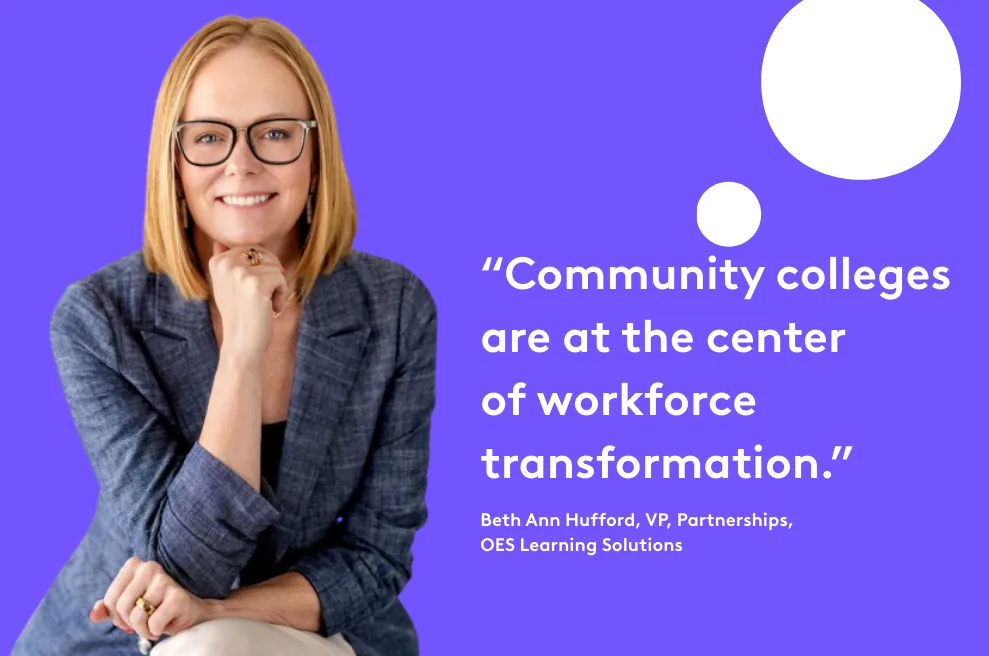
“Community colleges are the ones getting the money and doing the work right now. They’re nimble, they’re focused, and they’re deeply connected to their regions. They’re also the ones that have the flexibility to build programs. This makes them the center of workforce transformation.”
Turning Insight Into Impact
WDI 2026 reaffirmed what we see every day at OES: workforce education works best when strategy, speed, and learner-centered design come together. As funding models shift and expectations rise, the ability to deliver high-quality, workforce-aligned programs at scale isn’t just an advantage—it’s a necessity.
The future of work is being built now. And the institutions that succeed will be the ones best equipped to act on it.
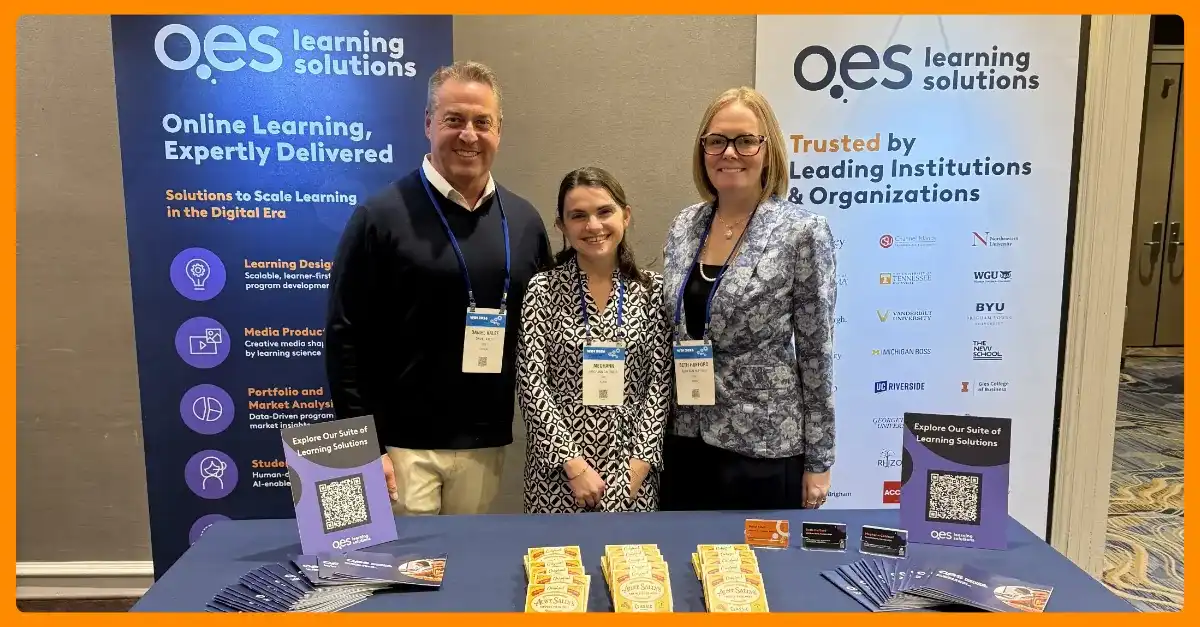
From left to right: Daniel Kalef, Meghann Caldwell, and Beth Hufford.